
As we mentioned on our blog, The harvest is one of the most important moments at Bodega del Abad, when we gather the raw material used to craft our wines. However, while the harvest is essential, the processes carried out in the winery once the grapes have been collected are no less important. After all, these are the techniques that result in the Mencía reds and Godello whites that you enjoy so much later on. A few days ago, we spoke to you about pressing and bleeding. Today, we want to tell you how we determine the sugar levels of our wines and the technique we follow to control the presence of malic acid in red wines until it is completely eliminated.
Firstly, regarding sugar levels, at Bodega del Abad we comply with the regulations set by the Regulatory Council of the Bierzo Designation of Origin, which governs our wines and stipulates that sugar levels must be below 4 to not be considered sweet wines. To determine the amount present in our wines, we use a method called GAB, in which we add a chemical product to a wine sample that has already completed fermentation.
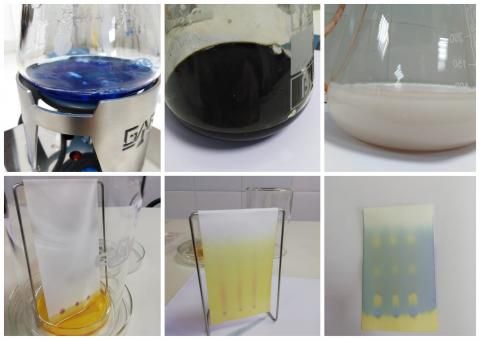
In these images, you can see the three steps of the sugar determination process. In the first photograph, the wine changes its hue to blue after adding the chemicals required for this test. The next step is to heat the mixture for exactly one and a half minutes, then cool it suddenly and add other products. This is when the color changes to black. Then, caustic soda is added to assess the sugar levels. At that point, the color turns white. If, after performing the measurement, we confirm that the sugar content is as desired, we stop the alcoholic fermentation of our whites and reds by applying cold to the cooling jackets surrounding the tanks. At that moment, in the case of Mencía wines, malolactic fermentation begins in the tank before the wine is transferred to barrels.
In this second group of photos, we show you the technique known as gas chromatography, which we use to determine if any malic acid remains in the wine. To do this, we place a strip, on which we have put a drop of wine from each tank, into the yellow chromatographic substance you see. After leaving it for approximately two hours, different types of spots will appear. In the case of the images illustrating this article, we can see the bottom line, corresponding to the wine; the line of spots in the middle, which shows the malic acid; and finally, the top line, which reflects the lactic acid.
When no spot appears in the center section, it means that we have transformed all the malic acid into lactic acid. At that point, the malolactic fermentation processes will be complete, and we can transfer the wine to barrels.
By transforming malic acid into lactic acid, we manage to refine the wines significantly, rounding them out and making them smoother on the palate.
The new vintage is already in progress; it won’t be long before we toast to the 2019 harvest with Bodega del Abad.